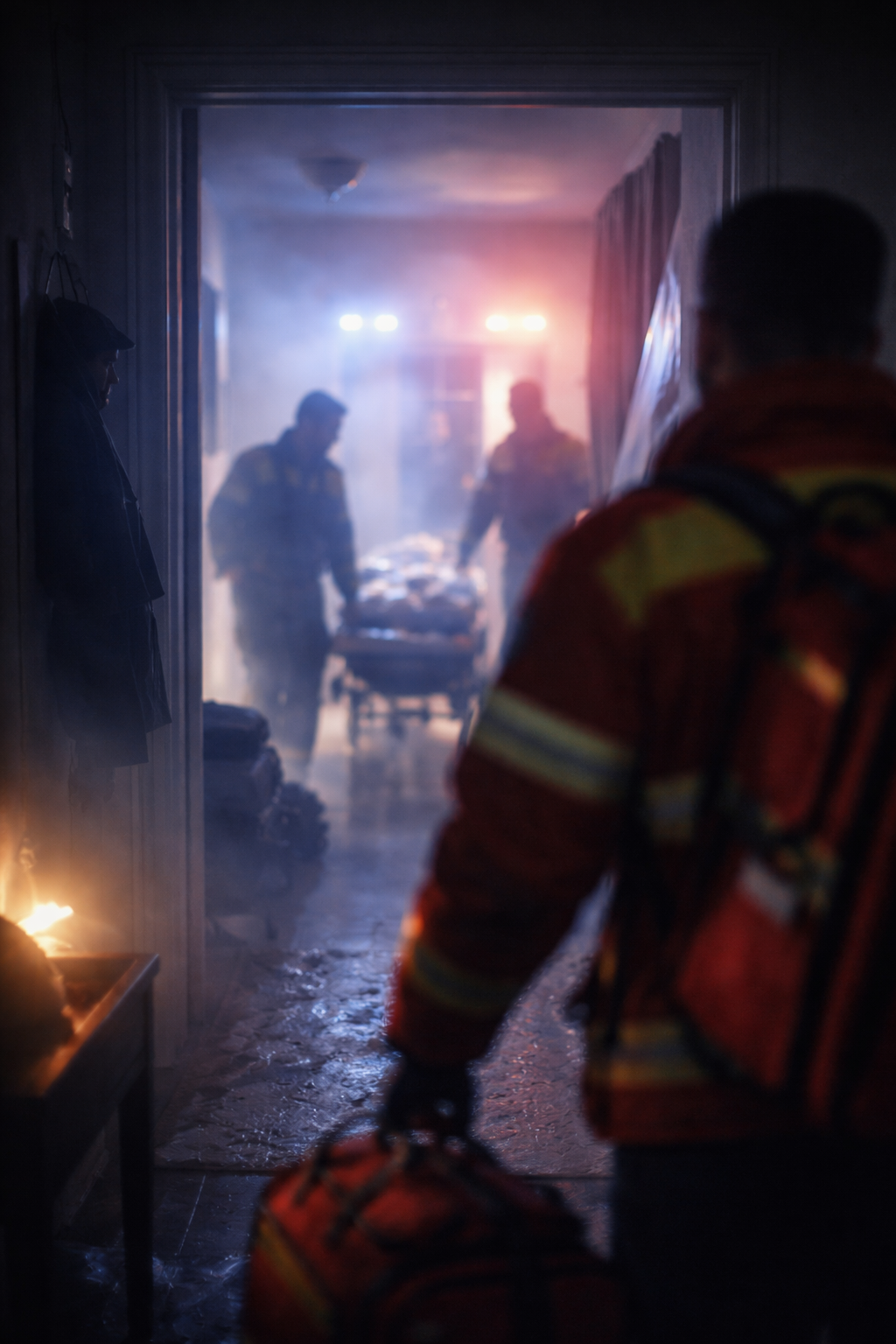
It’s freezing cold outside, but in the engine that was sitting in the bay before this call came out, it’s warm. I’m barely awake. It’s 2 AM. The call comes out as uncontrolled bleeding, medic level. A medic chase from another location marks up and is en route, and we also have a basic life support unit en route, but we will be the first advanced life support on scene. I will be in charge, and I will be responsible.
The dispatcher tells us it’s a suspected suicide attempt, and that a patient is lying in a pool of blood. I’m no longer sleepy. Adrenaline starts pumping through my body. The officer tells the driver to step on it, and we begin flying through roads and intersections. Sirens screaming, airhorn blaring. Even though the intersections are empty at this hour, the flashing lights create an eerie atmosphere as I prepare myself mentally for what I’m about to face.
We arrive on scene. I step out of the engine with my medical bag slung over my shoulder, scrambling to get my gloves on. The cold air hits my face, but I don’t feel it. Someone is outside waving for us to come help.
I step inside a stranger’s home. The smell of urine and fecal matter, along with animals left inside and uncared for, hangs in the air—but I barely notice. A woman, probably his mother, leads me upstairs.
I see the boy. A young man, not much younger than myself, lying in a bathtub in a pool of his own blood. He’s breathing slow and shallow, unconscious. His family has kept him alive by sheer desperation, stemming the bleeding from the deep cuts on both wrists with paper towels, washcloths, whatever they could find.
We stabilize. Tourniquets on both forearms. Time stands still.
I place my hand on his carotid. It’s fast, thready, and weak. He’s in shock and he’s dying. He needs blood, and the medic that’s on his way has it.
We package him up and carry him down the stairs. It’s clumsy, uncoordinated, and not pretty. But I need him in the ambulance where I can work.
In the back of the ambulance, I breathe a quick prayer for wisdom and start calling out what I need.
Two IVs. If we can’t get IVs, drill into his bone, I need access. He needs to be warm, get heated blankets. Make the back of the ambulance as hot as possible. Hook him up to the monitor. I need his vitals. Does he even have a blood pressure? Put the pads on. If he goes codes, we need to be ready to work him.
And we need a helicopter heading our direction. And I need a medic. A medic with blood. This boy needs blood.
He has good veins. I get the first IV on the first attempt. What now? I start a rapid infusion of saline, but saline doesn’t carry oxygen. He needs blood.
The medic arrives, and I breathe a sigh of relief. This is no longer my call. This is no longer my responsibility. The medic gets everything ready to administer blood, and we begin transporting to rendezvous with the helicopter.
The medic starts the blood, but the boy is still dying. His blood pressure is too low to perfuse his vital organs or his brain. He’s completely unconscious.
The medic tells me to start norepinephrine, basically adrenaline, as a drip to bring his blood pressure up without putting too much strain on his heart.
I start another IV for the medication while the medic continues the blood. I hang the norepinephrine and begin the drip. I’m sitting at the patient’s head, watching the medication go into one arm and the blood into the other. With both the norepinephrine and the blood running, the patient suddenly becomes lucid. He needs to be sedated, but we haven’t gotten there yet.
The boy looks at me and says, “I don’t want to die, but I don’t have anything to live for.”
I’m stunned. I just look at him. After a moment, I tell him, “You’re not going to die tonight.” And he doesn’t.
We sedate him. We transfer him to the helicopter. He’s flown to a Level I trauma center. He receives many more units of blood and spends a couple days in the ICU. His body is young, and it recovers quickly.
We saved his life. But we didn’t fix his problem.
We make the jokes, crossways for attention, longways for results. And we need the jokes. The jokes keep us sane. They allow us to keep doing our job. But this isn’t funny.
This boy will be discharged. He will go back to his home, the one that smells like animal urine and fecal matter. Back to his family, a family that’s already deeply dysfunctional with their own long list of addictions and mental health problems. Back to a community where there are few resources, and even fewer he has the ability to use.
And eventually, me or one of my friends will find him in a ditch. And we will either save his life again or pronounce him dead.
Because saving his life is easy.
But giving him something to live for…
Is it even possible?